# Jieyab ft Xquik
 # Update Note
1. Update infinity scroll and load new data for each search also in graph
2. Update data corelation
3. Fix business logic flow
4. Monitoring (Soon)
5. MCP (Soon)
6. Add more parameter for enrichment
7. Add no rate limit (throttle)
8. Add Google CSE data source
9. Expand data user profile post, follower and following, reply post, retweet post in graph
10. Add sentiment analysis for clustering data, pro, neutral, con. Based on archive data and dump data
11. Add more data source and other parameter (soon) still research
12. Add more detail data source for the context
13. Auto repair broken archive and sentiment analysis data dump
14. Update rendering data in sentiment analysis
## Features
- **Multi-source search** — one query fans out to Cookie, Xquik API,
Wayback Machine, and Google CSE in parallel, each result tagged with
which source it came from.
- **10 extraction tools** — tweet search, follower/following explorer, post
(timeline) extractor, article extractor, community posts, tweet replies,
tweet retweeters, geo-tagged search with a map view, Wayback archive
search, and multi-source search.
- **Infinite scroll + inline nested reply threads** — scroll to load more
pages automatically; expand a reply's own replies in place, recursively,
the way X's own UI threads a conversation.
- **Relationship graph** (`/graph`) — a Cytoscape-based node graph. Select a
node to expand its replies, retweeters, posts, followers, or following;
pivot from any tweet straight to its author (no extra request — the data's
already on the tweet); box-select multiple nodes and drag them together;
edges are labeled by relationship (*replied by*, *followed by*, *authored
by*, ...) and a distinct color flags where two different paths through the
graph converge on the same account or tweet.
- **Archive** (`/archives`) — one-click (or auto-) save of a search's full
raw results, including downloaded media, browsable and re-searchable later
independent of whether the source is still reachable.
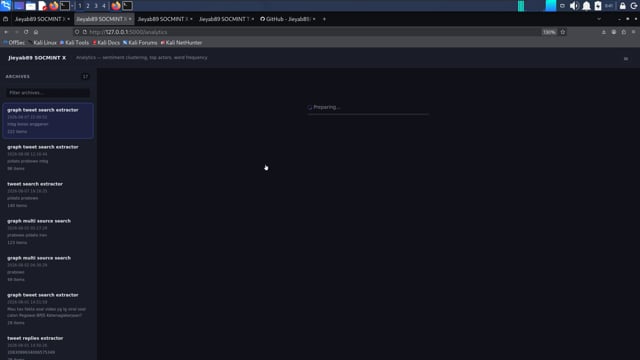
- **Analytics** (`/analytics`) — sentiment clustering (pro / neutral / con)
over a saved archive, a Maltego-style social network graph, plus who posts
most, what's driving the most engagement, and word frequency — see
[Sentiment Analysis](#sentiment-analysis) below.
- **Account-age forensics** — every result with a numeric X/Twitter ID gets
its account creation date decoded straight from the ID's Snowflake bits
(no extra API call), flagged New / Recent / Established.
- **Security-conscious by default** — strict CSP with per-request nonces,
hardened cookies, a whitelisted SSRF-safe video proxy, per-source request
throttling to protect the logged-in account from rate limits, and
URL-scheme validation everywhere a scraped link is rendered as an image or
embedded in CSS.
## Data Source
1. Xquik API (subs there is a price)
2. Cookie (your account cookie session)
3. Wayback Machine (Cdx API)
4. Goole CSE API (free quota 100 per day u can increase u limit with buy the service)
## Setup
**1. Create a virtual environment** (a private folder for this project's
Python packages, kept separate from anything else on your machine — only
needs doing once):
```bash
python3 -m venv .venv
```
**2. Activate it** (do this every time you come back to work on the
project):
- macOS / Linux: `source .venv/bin/activate`
- Windows (Command Prompt): `.venv\Scripts\activate.bat`
- Windows (PowerShell): `.venv\Scripts\Activate.ps1`
Your terminal prompt should now start with `(.venv)`.
**3. Install dependencies:**
```bash
pip install -r requirements.txt
```
This installs Flask, the scraping/API clients, and the multilingual
sentiment model's packages (`torch`, `transformers`) in one go — see
[Sentiment Analysis](#sentiment-analysis) for what that model does. If your
machine has no NVIDIA GPU, torch's default download can be a few GB larger
than it needs to be; keep it small by running this once first, then
installing as above:
```bash
pip install --index-url https://download.pytorch.org/whl/cpu torch
```
Whenever the project's dependencies change (new features, updates), just
re-run:
```bash
pip install -r requirements.txt --upgrade
```
**4. Configure the Google CSE data source** (optional — only needed if you
want that source; everything else works without it):
1. Enable "Custom Search API" in the Google API Console.
# Update Note
1. Update infinity scroll and load new data for each search also in graph
2. Update data corelation
3. Fix business logic flow
4. Monitoring (Soon)
5. MCP (Soon)
6. Add more parameter for enrichment
7. Add no rate limit (throttle)
8. Add Google CSE data source
9. Expand data user profile post, follower and following, reply post, retweet post in graph
10. Add sentiment analysis for clustering data, pro, neutral, con. Based on archive data and dump data
11. Add more data source and other parameter (soon) still research
12. Add more detail data source for the context
13. Auto repair broken archive and sentiment analysis data dump
14. Update rendering data in sentiment analysis
## Features
- **Multi-source search** — one query fans out to Cookie, Xquik API,
Wayback Machine, and Google CSE in parallel, each result tagged with
which source it came from.
- **10 extraction tools** — tweet search, follower/following explorer, post
(timeline) extractor, article extractor, community posts, tweet replies,
tweet retweeters, geo-tagged search with a map view, Wayback archive
search, and multi-source search.
- **Infinite scroll + inline nested reply threads** — scroll to load more
pages automatically; expand a reply's own replies in place, recursively,
the way X's own UI threads a conversation.
- **Relationship graph** (`/graph`) — a Cytoscape-based node graph. Select a
node to expand its replies, retweeters, posts, followers, or following;
pivot from any tweet straight to its author (no extra request — the data's
already on the tweet); box-select multiple nodes and drag them together;
edges are labeled by relationship (*replied by*, *followed by*, *authored
by*, ...) and a distinct color flags where two different paths through the
graph converge on the same account or tweet.
- **Archive** (`/archives`) — one-click (or auto-) save of a search's full
raw results, including downloaded media, browsable and re-searchable later
independent of whether the source is still reachable.
- **Analytics** (`/analytics`) — sentiment clustering (pro / neutral / con)
over a saved archive, a Maltego-style social network graph, plus who posts
most, what's driving the most engagement, and word frequency — see
[Sentiment Analysis](#sentiment-analysis) below.
- **Account-age forensics** — every result with a numeric X/Twitter ID gets
its account creation date decoded straight from the ID's Snowflake bits
(no extra API call), flagged New / Recent / Established.
- **Security-conscious by default** — strict CSP with per-request nonces,
hardened cookies, a whitelisted SSRF-safe video proxy, per-source request
throttling to protect the logged-in account from rate limits, and
URL-scheme validation everywhere a scraped link is rendered as an image or
embedded in CSS.
## Data Source
1. Xquik API (subs there is a price)
2. Cookie (your account cookie session)
3. Wayback Machine (Cdx API)
4. Goole CSE API (free quota 100 per day u can increase u limit with buy the service)
## Setup
**1. Create a virtual environment** (a private folder for this project's
Python packages, kept separate from anything else on your machine — only
needs doing once):
```bash
python3 -m venv .venv
```
**2. Activate it** (do this every time you come back to work on the
project):
- macOS / Linux: `source .venv/bin/activate`
- Windows (Command Prompt): `.venv\Scripts\activate.bat`
- Windows (PowerShell): `.venv\Scripts\Activate.ps1`
Your terminal prompt should now start with `(.venv)`.
**3. Install dependencies:**
```bash
pip install -r requirements.txt
```
This installs Flask, the scraping/API clients, and the multilingual
sentiment model's packages (`torch`, `transformers`) in one go — see
[Sentiment Analysis](#sentiment-analysis) for what that model does. If your
machine has no NVIDIA GPU, torch's default download can be a few GB larger
than it needs to be; keep it small by running this once first, then
installing as above:
```bash
pip install --index-url https://download.pytorch.org/whl/cpu torch
```
Whenever the project's dependencies change (new features, updates), just
re-run:
```bash
pip install -r requirements.txt --upgrade
```
**4. Configure the Google CSE data source** (optional — only needed if you
want that source; everything else works without it):
1. Enable "Custom Search API" in the Google API Console.
 2. Get an API key.
 Check the result in the table.
 3. Set up a Programmable Search Engine to get a `cx` key.
 4. Add the sites to crawl, e.g. `twitter.com` and `x.com`.
 **5. Copy `config.ini.example` to `config.ini`** and fill in your keys.
**6. Run the app:**
```bash
python app.py
```
Open `http://127.0.0.1:5000`.
The first time you open the Analytics page, it downloads the sentiment
model (~1.1GB) from Hugging Face automatically — needs an internet
connection once, then it's cached locally and loads instantly after that.
## Usage
### Search (`/`)
Pick a tool from the dropdown, fill in the field it asks for (query,
username, tweet ID, ...), and hit **Run**. Cookie-only tools (marked
`[Cookie]`) always use your logged-in session; everything else lets you
toggle between **Cookie** (your session, no xquik quota used) and **xquik
API** (uses your API key's quota) mode.
- Scroll down to auto-load more pages on any tool that supports pagination.
- Any card whose post has replies of its own gets an **Expand N replies**
button — click it to thread the conversation inline, as deep as it
actually goes.
- Toggle **Auto Archive** before running a search to save results as you go
(including every scrolled-in page) — see [Archives](#archives-archives).
- **Geo Post Extractor** switches the results view to a map, geocoding each
author's profile location.
- The `↓ JSON` button downloads exactly what's on screen as raw JSON.
### Graph (`/graph`)
Same 10 tools, rendered as a node graph instead of a card list.
- Click a node to inspect its full raw data in the side panel.
- **Expand Replies / Retweets** (tweet or reply nodes), **Expand Posts /
Followers / Following** (user or retweeter nodes), and **View Author
Profile** (tweet/reply nodes — pulls the author out as their own node,
for free) all attach new nodes with a labeled edge showing the
relationship.
- **Shift/Alt/Ctrl + drag** on empty canvas to box-select multiple nodes;
drag any one of them to move the whole selection together. Plain drag
still pans, scroll still zooms.
- A **yellow edge** means two different paths through the graph converged
on the same node — worth a second look.
- **Archive All** / **Dump JSON** export everything currently on canvas.
- Click the **?** button (bottom-left) for the full legend.
### Archives (`/archives`)
Browse everything saved from Search or Graph. Pick an archive from the
sidebar to see its full raw results and any downloaded media. Archives
persist independent of whether the original source is still reachable —
useful for content that gets deleted or a session that expires.
### Analytics (`/analytics`)
Pick a saved archive to run sentiment clustering and the surrounding
aggregates over it:
- **Sentiment clustering** — every item with text gets classified **pro** /
**neutral** / **con**, shown as a diverging bar plus per-category tiles
you can click to filter the item list below.
- **Social network graph** — click **View as Graph** to see accounts as
nodes, sized by how many items they posted in this archive and colored by
their own pro/neutral/con mix, Maltego-style. Edges show reply
relationships found in the archive; click a node to see its per-account
sentiment breakdown.
- **Most active accounts** — who shows up most often in that archive.
- **Most engagement** — which items drove the most reply+retweet+like
activity.
- **Word frequency** — a word cloud sized by how often each word appears.
- **Item browser** — every scored item, filterable by sentiment and
searchable by text/author, with the model's confidence (or, in lexicon
fallback mode, the exact matched words) shown per item — a classification
is always inspectable, never a black box.
## Sentiment Analysis
Two backends, tried in this order (see `sentiment.py`):
1. **ML (preferred)** — [`cardiffnlp/twitter-xlm-roberta-base-sentiment`](https://huggingface.co/cardiffnlp/twitter-xlm-roberta-base-sentiment),
an XLM-RoBERTa model fine-tuned for tweet sentiment across 8 languages
(Arabic, English, French, German, Hindi, Italian, Portuguese, Spanish).
Its underlying pretraining covers roughly 100 languages, so it degrades
gracefully rather than failing outright on a language outside that
fine-tuned set — this is what makes the tool usable for a global
audience, not just Indonesian speakers. Requires `torch` + `transformers`
(see `requirements.txt`) and downloads ~1.1GB of model weights from
Hugging Face the first time it runs.
2. **Lexicon fallback** — a hand-built Indonesian positive/negative word
list with negation handling (e.g. *"tidak bagus"* flips from positive to
negative). Used automatically whenever `torch`/`transformers` aren't
installed, so a lightweight install still has a working — if
Indonesian-only — sentiment feature instead of a hard failure.
The `/api/analytics/` response always reports which backend
(`"ml"` or `"lexicon"`) produced its results, and the Analytics page's
banner reflects it. Neither backend is a ground-truth classifier — short
text, sarcasm, and irony degrade accuracy either way. Treat results as a
starting point for investigation, not a verdict.
# Results
[](https://vimeo.com/1216677900)
Xquik Dashboard
**5. Copy `config.ini.example` to `config.ini`** and fill in your keys.
**6. Run the app:**
```bash
python app.py
```
Open `http://127.0.0.1:5000`.
The first time you open the Analytics page, it downloads the sentiment
model (~1.1GB) from Hugging Face automatically — needs an internet
connection once, then it's cached locally and loads instantly after that.
## Usage
### Search (`/`)
Pick a tool from the dropdown, fill in the field it asks for (query,
username, tweet ID, ...), and hit **Run**. Cookie-only tools (marked
`[Cookie]`) always use your logged-in session; everything else lets you
toggle between **Cookie** (your session, no xquik quota used) and **xquik
API** (uses your API key's quota) mode.
- Scroll down to auto-load more pages on any tool that supports pagination.
- Any card whose post has replies of its own gets an **Expand N replies**
button — click it to thread the conversation inline, as deep as it
actually goes.
- Toggle **Auto Archive** before running a search to save results as you go
(including every scrolled-in page) — see [Archives](#archives-archives).
- **Geo Post Extractor** switches the results view to a map, geocoding each
author's profile location.
- The `↓ JSON` button downloads exactly what's on screen as raw JSON.
### Graph (`/graph`)
Same 10 tools, rendered as a node graph instead of a card list.
- Click a node to inspect its full raw data in the side panel.
- **Expand Replies / Retweets** (tweet or reply nodes), **Expand Posts /
Followers / Following** (user or retweeter nodes), and **View Author
Profile** (tweet/reply nodes — pulls the author out as their own node,
for free) all attach new nodes with a labeled edge showing the
relationship.
- **Shift/Alt/Ctrl + drag** on empty canvas to box-select multiple nodes;
drag any one of them to move the whole selection together. Plain drag
still pans, scroll still zooms.
- A **yellow edge** means two different paths through the graph converged
on the same node — worth a second look.
- **Archive All** / **Dump JSON** export everything currently on canvas.
- Click the **?** button (bottom-left) for the full legend.
### Archives (`/archives`)
Browse everything saved from Search or Graph. Pick an archive from the
sidebar to see its full raw results and any downloaded media. Archives
persist independent of whether the original source is still reachable —
useful for content that gets deleted or a session that expires.
### Analytics (`/analytics`)
Pick a saved archive to run sentiment clustering and the surrounding
aggregates over it:
- **Sentiment clustering** — every item with text gets classified **pro** /
**neutral** / **con**, shown as a diverging bar plus per-category tiles
you can click to filter the item list below.
- **Social network graph** — click **View as Graph** to see accounts as
nodes, sized by how many items they posted in this archive and colored by
their own pro/neutral/con mix, Maltego-style. Edges show reply
relationships found in the archive; click a node to see its per-account
sentiment breakdown.
- **Most active accounts** — who shows up most often in that archive.
- **Most engagement** — which items drove the most reply+retweet+like
activity.
- **Word frequency** — a word cloud sized by how often each word appears.
- **Item browser** — every scored item, filterable by sentiment and
searchable by text/author, with the model's confidence (or, in lexicon
fallback mode, the exact matched words) shown per item — a classification
is always inspectable, never a black box.
## Sentiment Analysis
Two backends, tried in this order (see `sentiment.py`):
1. **ML (preferred)** — [`cardiffnlp/twitter-xlm-roberta-base-sentiment`](https://huggingface.co/cardiffnlp/twitter-xlm-roberta-base-sentiment),
an XLM-RoBERTa model fine-tuned for tweet sentiment across 8 languages
(Arabic, English, French, German, Hindi, Italian, Portuguese, Spanish).
Its underlying pretraining covers roughly 100 languages, so it degrades
gracefully rather than failing outright on a language outside that
fine-tuned set — this is what makes the tool usable for a global
audience, not just Indonesian speakers. Requires `torch` + `transformers`
(see `requirements.txt`) and downloads ~1.1GB of model weights from
Hugging Face the first time it runs.
2. **Lexicon fallback** — a hand-built Indonesian positive/negative word
list with negation handling (e.g. *"tidak bagus"* flips from positive to
negative). Used automatically whenever `torch`/`transformers` aren't
installed, so a lightweight install still has a working — if
Indonesian-only — sentiment feature instead of a hard failure.
The `/api/analytics/` response always reports which backend
(`"ml"` or `"lexicon"`) produced its results, and the Analytics page's
banner reflects it. Neither backend is a ground-truth classifier — short
text, sarcasm, and irony degrade accuracy either way. Treat results as a
starting point for investigation, not a verdict.
# Results
[](https://vimeo.com/1216677900)
Xquik Dashboard
 Dasboard Home
 Archive

 Graph
Graph
 Search in Graph

 Vidio
Vidio
 Dir Output
 Sentiment Analysis


 Follower and Following
 # Help
About SnowflakeID -> Twitter userid : https://en.wikipedia.org/wiki/Snowflake_ID
About paramater was provided in data and dump with json file type
# Help
About SnowflakeID -> Twitter userid : https://en.wikipedia.org/wiki/Snowflake_ID
About paramater was provided in data and dump with json file type
 Xquik API DOC
Offc doc: https://docs.xquik.com/api-reference/overview
Soon i will check more detail about Twitter or X mechanism and business logic also endpoint API was listed in Mobile and Web
Wayback archive data source
The server connection to the Wayback Machine archive is often down, so try bumping the thread and don't set the throttle too high, and try checking the connection manually using curl.
Xquik API DOC
Offc doc: https://docs.xquik.com/api-reference/overview
Soon i will check more detail about Twitter or X mechanism and business logic also endpoint API was listed in Mobile and Web
Wayback archive data source
The server connection to the Wayback Machine archive is often down, so try bumping the thread and don't set the throttle too high, and try checking the connection manually using curl.